FTSE Russell, a major global index provider, has announced changes affecting Indonesian equities while reaffirming the country’s standing in its market classification framework. In its latest review, the institution removed 14 Indonesian listed companies from its indices. At the same time, it retained Indonesia’s designation as a Secondary Emerging Market and did not place the country on its Watch List.
The announcement underscores a dual message for Indonesia’s capital market: individual stock exclusions will take effect, yet the broader market classification remains stable. Officials at the Indonesia Stock Exchange (BEI) have responded by stressing continued reform efforts aimed at transparency, liquidity, and stronger oversight.
## Indonesia Retains Secondary Emerging Market Status
According to FTSE Russell’s official statement, Indonesia’s status as a Secondary Emerging Market is unchanged. The provider also confirmed that Indonesia was not added to the Watch List during the country classification evaluation previously announced.
The firm noted that Indonesian market authorities have introduced several measures intended to strengthen capital market transparency. FTSE Russell welcomed these positive developments after reviewing feedback from market participants and external advisory committees.
However, the index provider concluded that more time is needed to assess how effective the recent steps have been. Those steps focus on improving the transparency of shareholder data, reinforcing supervisory monitoring and the criteria applied in that process, and supporting consistent, ongoing regulatory enforcement.
As a result, the approach taken in the September 2026 index review will continue into the December 2026 review. This means Indonesia’s Secondary Emerging classification stands, without Watch List placement, while further evaluation of market reforms proceeds.
## BEI Emphasizes Respect for Index Providers and Ongoing Reforms
BEI President Director Jeffrey Hendrik stated that the exchange respects the authority and independence of global index providers such as FTSE Russell. He affirmed that BEI will remain consistent in pursuing reforms designed to deliver greater transparency, higher liquidity, and more effective supervision.
His comments reflect the exchange’s position that structural improvements in market quality remain a priority regardless of periodic index constituent changes by external providers.
## Fourteen Indonesian Stocks Set for Removal
In its quarterly review for December 2026, FTSE Russell decided to exclude 14 Indonesian company shares from its indices. The removals span multiple market-capitalization segments: Large Cap, Mid Cap, Small Cap, and Micro Cap. The index changes are scheduled to take effect on Monday, 21 December 2026.
### Breakdown by Capitalization Category
In the Large Cap segment, one stock was removed: PT Bank Syariah Indonesia Tbk (BRIS).
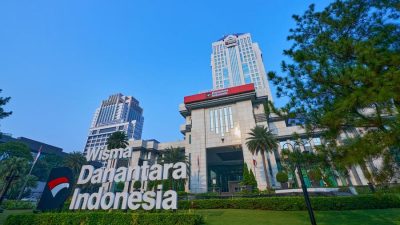
In Mid Cap, two stocks were dropped: PT Dayamitra Telekomunikasi Tbk (MTEL), also known as Mitratel, and PT Tower Bersama Infrastructure Tbk (TBIG).
In Small Cap, FTSE Russell excluded PT Mitra Adiperkasa Tbk (MAPI) and PT Pabrik Kertas Tjiwi Kimia Tbk (TKIM).
The largest number of removals occurred in Micro Cap, where nine Indonesian issuers were taken out of the index. These are PT Bank Mayapada Internasional Tbk (MAYA), PT Indomobil Sukses Internasional Tbk (IMAS), PT Multi Bintang Indonesia Tbk (MLBI), PT Sarana Meditama Metropolitan Tbk (SAME), PT Sariguna Primatirta Tbk (CLEO), PT Sawit Sumbermas Sarana Tbk (SSMS), PT Sumber Tani Agung Resources Tbk (STTA), PT Temas Tbk (TMAS), and PT Tempo Scan Pacific Tbk (TSPC).
### Provisional Nature of the Review
FTSE Russell emphasized that the review results remain provisional and may still change until the close of trading on Friday, 4 December 2026. From Monday, 7 December 2026 onward, the index review changes will be treated as final.
## Implications for Market Participants
The simultaneous retention of Secondary Emerging Market status and the removal of specific stocks means Indonesia’s overall classification in FTSE Russell’s framework is stable, while the composition of the indices that track Indonesian equities will shift. Passive funds and other products linked to these indices typically adjust holdings when constituents change, so the scheduled effective date of 21 December 2026 is the key implementation point for the stock-level exclusions.
For issuers that remain in the indices, continued inclusion can support visibility among international investors who use FTSE Russell benchmarks. For those removed, the change reflects the outcome of the provider’s December 2026 quarterly review criteria rather than a change in the country’s market tier.
BEI’s stated commitment to transparency, liquidity, and supervision aligns with the areas FTSE Russell cited as needing further time for effectiveness assessment—shareholder data transparency, supervisory monitoring, and consistent enforcement. The continuation of the September 2026 treatment into the December review indicates that the global provider is monitoring progress without altering Indonesia’s Secondary Emerging designation or adding a Watch List flag at this stage.
In summary, FTSE Russell’s announcement leaves Indonesia’s Secondary Emerging Market status intact, keeps the country off the Watch List, removes 14 stocks across Large, Mid, Small, and Micro Cap categories effective 21 December 2026 (subject to finalization after 4 December 2026), and has drawn a response from BEI centered on respect for index-provider independence and sustained market reform.